
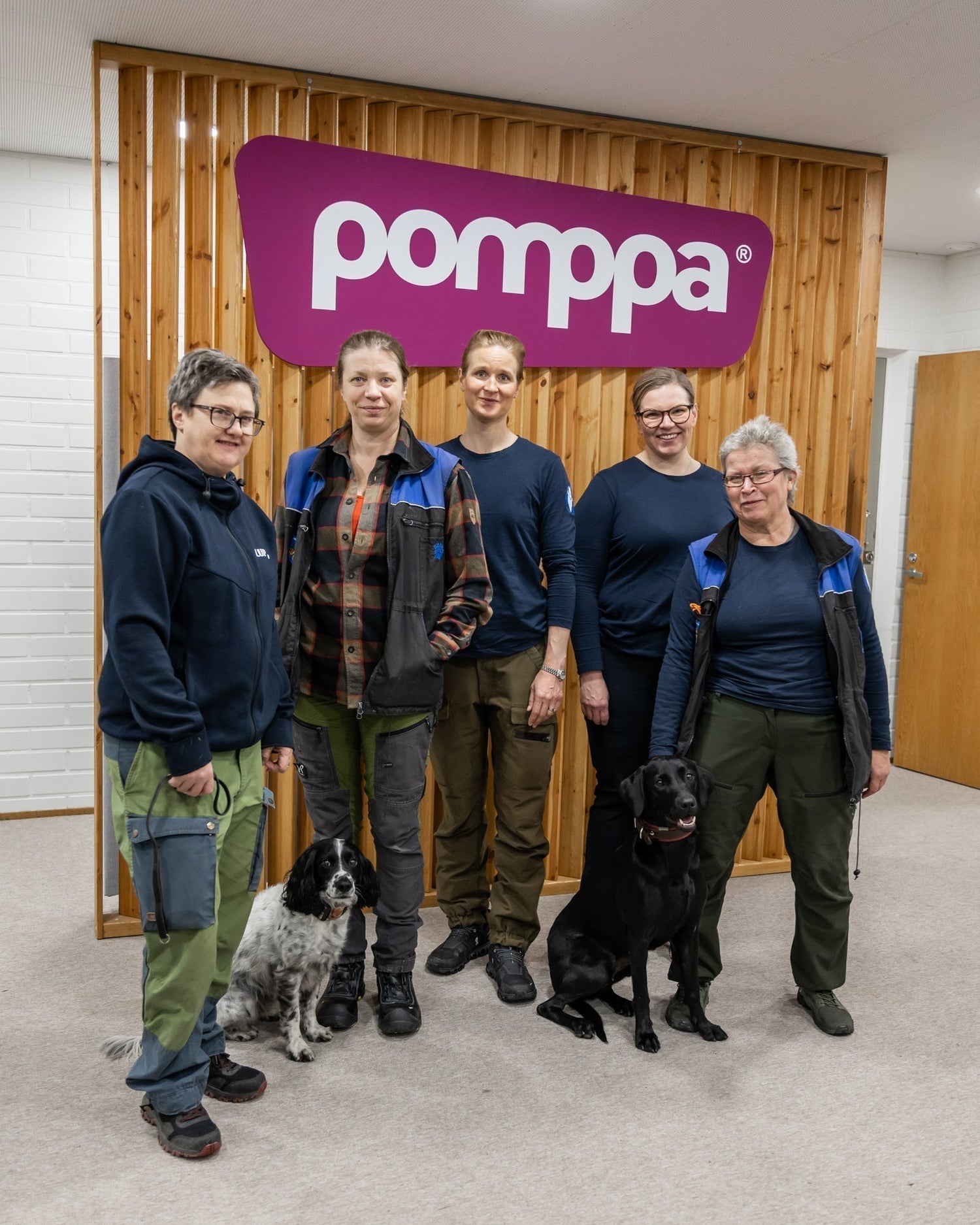
Search and rescue dogs are tested and officially approved dogs that support the police and other authorities in locating missing persons. For Jenni Räike, training coordinator and group instructor at the Western Uusimaa Search and Rescue Dog Association (LUP), search and rescue work has become a long-term passion.
📦 LUP got to train at Pomppa’s warehouse
Pomppa supports LUP during the 2025–2026 season both financially and by providing suitable Pomppa gear for the dogs. In October, Pomppa also offered its large warehouse hall as a special training space for the association.
LUP’s training sessions are almost always held outdoors – just like real searches, which take place year-round and in all kinds of weather. That’s why a training day inside Pomppa’s warehouse felt special.
“Access to indoor spaces is rare. We gained valuable practice because indoor environments are always more challenging when it comes to scent work,” Jenni explains. The group included dogs at different levels: a couple of fully trained alert dogs and several dogs just starting their careers. Running between stacks of cardboard boxes provided motivating and suitable training for everyone.
 Jenni and Cocker Spaniel Pöpö
🐶 Pöpö – Small but mighty
Jenni is currently training her almost four-year-old cocker spaniel, Pöpö. Pöpö passed the official authority inspection in August and is the association’s newest alert dog.
“Pöpö may be small, but she’s determined, incredibly cute, and wants to get everything right. She’s a perfect ten,” Jenni says proudly.
Pöpö is Jenni’s third search and rescue dog, and her previous dogs have given her a strong foundation. Her own abilities and dog-training skills grow year after year.
Jenni’s own path into the world of search and rescue dogs began by chance.
“I was looking for a new scent-based hobby with my then-current dog and came across a magazine article about search and rescue dogs. I contacted local associations, visited LUP’s training sessions – and I’ve been involved ever since. What started as a fun hobby for a dog who loves to sniff has developed into something much more meaningful.”
 Kirsi and Labrador Retriever Pinna
🦮 How to get started in search and rescue dog training
There are associations under both the Service Dog Federation and the Search and Rescue Dog Federation in Finland. The Service Dog Federation offers trials that can be completed without aiming for operational searches, while the Search and Rescue Dog Federation focuses solely on SAR work. In some associations you can train with relaxed goals, but LUP’s mission is to support authorities.
“If you want to eventually take part in real callouts, you must develop your own skills as well. Besides dog-training skills, the sport requires orienteering, first-aid skills, and the ability to work outside in any weather.”
LUP accepts new members through an introductory course held twice a year. The course provides an overview of the requirements and gives a realistic picture of what the work involves and who it suits.
 Anni and Labrador Retriever Topi
🐾 Training in all conditions
LUP’s training program is diverse. It includes:
- weekly training sessions
- monthly alert exercises
- specialized training and tracking practice every other week
- group training sessions without formal instruction
In addition, a lot of practice happens in smaller groups and in everyday settings. The dogs are constantly learning in everyday situations.
 Vera and Cocker Spaniel Elmo
🐕 What kind of dog is suited for search and rescue work?
There is great variety in the breeds, but a few key traits are important:
- the dog must be trainable and social
- very small or very large and heavy dogs may face challenges in rough terrain
- the dog must be able to work amid distractions
“A search and rescue dog doesn’t have to love everyone, but it must be able to work around other dogs and people,” Jenni summarizes.
 Elina and Entlebuch Mountain Dog Bennji